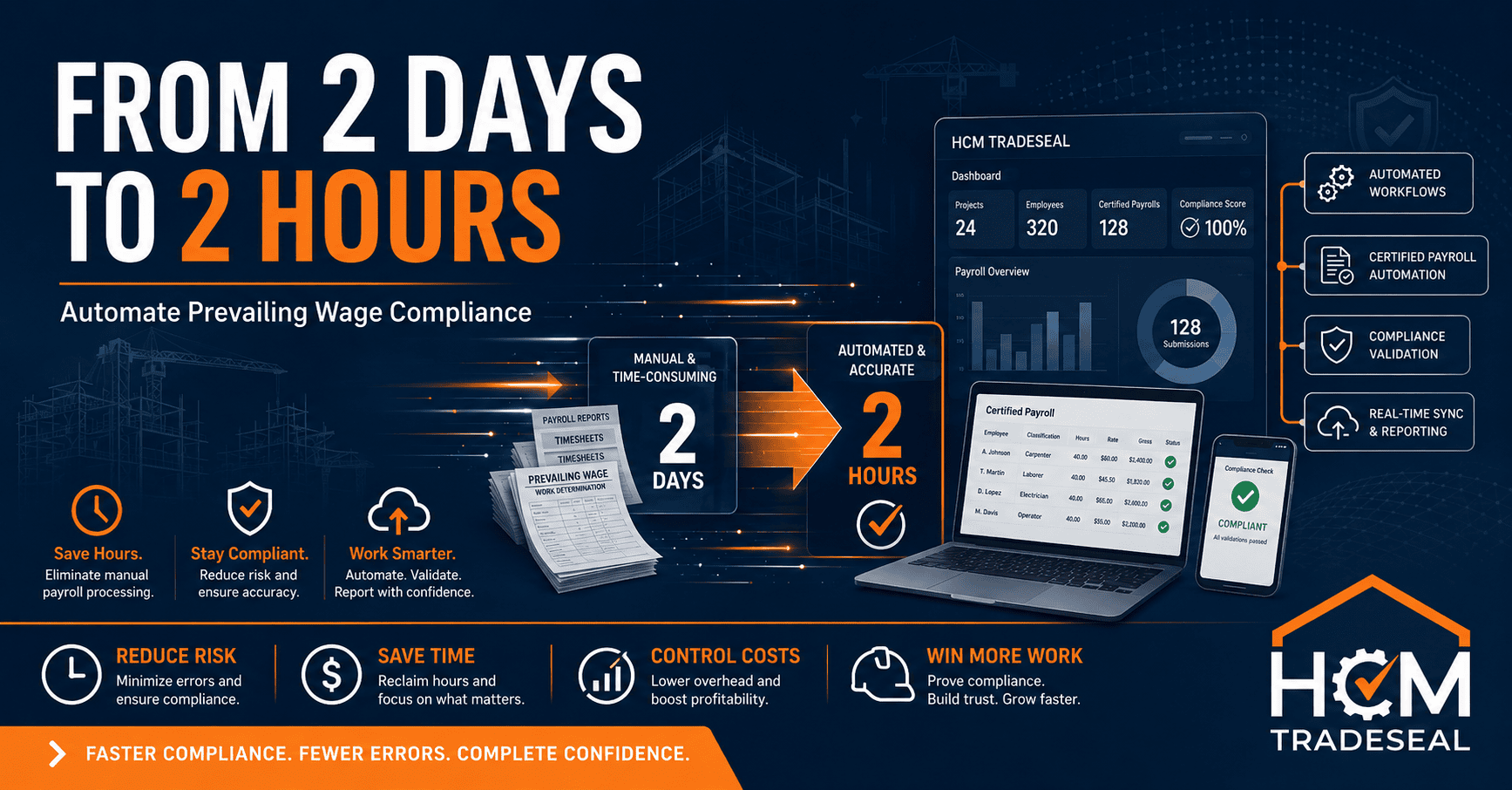
From 2 days to 2 hours: How prevailing wage automation streamlines certified payroll compliance

Andrew Ho is a Director of Revenue at HCM TradeSeal, bringing six years of experience in the Human Capital Management industry. He specializes in demonstrating how HCM TradeSeal helps organizations streamline prevailing wage and union reporting compliance.
Organizations managing prevailing wage projects often spend days reviewing wage determinations, validating worker classifications, calculating fringe benefits, and preparing certified payroll reports. These manual processes increase compliance risk, create administrative bottlenecks, and slow payroll operations.
With modern prevailing wage automation solutions, contractors, payroll teams, and compliance professionals can reduce manual effort, improve accuracy, and automate certified payroll reporting. What once took two days can often be completed in just two hours through automated compliance validation and payroll workflows.
In this article, we’ll explore how prevailing wage automation helps organizations improve compliance, reduce payroll errors, and streamline certified payroll reporting.
Why manual prevailing wage compliance takes so long
Managing prevailing wage compliance involves much more than processing payroll.
Before payroll can be finalized, teams often need to:
- Review wage determinations
- Verify employee classifications
- Calculate fringe benefit obligations
- Validate union requirements
- Track apprentice-to-journeyman ratios
- Compare payroll records against project requirements
- Prepare certified payroll reports
- Respond to compliance inquiries and audits
Many organizations still rely on spreadsheets, manual reviews, and disconnected systems to manage these tasks. As the number of projects grows, so does the complexity and administrative burden.
The hidden costs of manual prevailing wage and certified payroll processes
Manual compliance workflows create costs that extend far beyond labor hours.
Common challenges include:
- Payroll processing delays
- Wage determination errors
- Incorrect fringe benefit calculations
- Certified payroll reporting mistakes
- Increased audit risk
- Costly corrections and rework
- Dependence on institutional knowledge
A single compliance error can trigger reporting issues, project delays, or additional administrative work. For contractors working across multiple jurisdictions, the risks multiply quickly.
How prevailing wage automation improves payroll compliance
Prevailing wage automation replaces repetitive manual tasks with automated validations and compliance workflows.
Rather than reviewing every payroll record manually, organizations can automatically validate payroll data against prevailing wage requirements before payroll is finalized.
Wage rate validation
Automated systems compare employee pay rates against applicable prevailing wage determinations and identify discrepancies before payroll is processed.
Fringe benefit compliance
Automation helps verify fringe benefit allocations and credits while reducing the need for manual calculations.
Union payroll compliance
Organizations can apply union-specific rules, reciprocity requirements, and benefit obligations consistently across projects.
Certified payroll automation
Automated certified payroll reporting reduces administrative effort by generating reports directly from validated payroll data.
Continuous compliance monitoring
Instead of relying on periodic audits, organizations can monitor compliance throughout the payroll cycle and address issues proactively.
Example: Reducing certified payroll processing from 2 days to 2 hours
Consider a contractor managing multiple prevailing wage projects.
Without automation, the payroll team may spend two full days:
- Gathering wage determinations
- Reviewing classifications
- Calculating fringes
- Verifying union requirements
- Identifying payroll discrepancies
- Correcting errors
- Preparing certified payroll reports
With prevailing wage automation, most of these activities occur automatically through compliance rules and validation workflows.
Rather than searching for problems manually, payroll professionals focus only on exceptions that require review.
The result is a faster, more efficient process that can reduce administrative effort from days to hours.
Scaling prevailing wage compliance with automated workflows
As prevailing wage regulations continue to evolve, organizations need compliance processes that can scale with project growth.
Benefits of prevailing wage compliance software include:
- Reduced manual effort
- Faster payroll processing
- Improved payroll accuracy
- Greater audit readiness
- Consistent compliance practices
- Enhanced visibility into compliance risks
- Increased operational efficiency
Automation allows payroll and compliance teams to manage growth without adding complexity or administrative overhead.
How HCM TradeSeal helps automate prevailing wage compliance
HCM TradeSeal helps organizations automate prevailing wage compliance, certified payroll reporting, union compliance, and fringe benefit validation without replacing their existing payroll systems.
By integrating with payroll and timekeeping platforms, HCM TradeSeal validates wage rates, classifications, fringe requirements, and compliance rules before payroll is finalized.
This enables organizations to:
- Reduce compliance-related manual work
- Improve payroll accuracy
- Automate certified payroll reporting
- Strengthen audit readiness
- Identify compliance risks earlier
For organizations still spending days managing prevailing wage compliance, automation provides a more scalable and efficient approach.
The difference between two days and two hours isn’t simply working faster—it’s eliminating manual compliance work altogether.
Frequently asked questions about prevailing wage automation
What is prevailing wage automation?
Prevailing wage automation uses software to validate wage rates, worker classifications, fringe benefits, union requirements, and certified payroll reporting obligations automatically.
How does certified payroll automation work?
Certified payroll automation integrates with payroll and timekeeping systems to validate payroll records against prevailing wage requirements and generate compliant reports automatically.
Can prevailing wage compliance software reduce compliance risk?
Yes. Automated compliance validation helps identify wage discrepancies, fringe benefit issues, classification errors, and reporting gaps before payroll is finalized.
Who benefits from prevailing wage automation?
General contractors, subcontractors, payroll departments, compliance teams, HR professionals, and public works contractors all benefit from automating prevailing wage compliance processes.
About
Founded in 2020, HCM TradeSeal has become a Human Capital Management’s top choice for Construction industry compliance. Recognized as the “Prevailing Wage Compliance Service of the Year 2025” by ManageHR magazine, HCM TradeSeal offers a proven integration with the nations most popular Payroll and ERP providers.
What sets us apart? We specialize in assisting companies with complex union requirements and Davis-Bacon compliance. Our full-service rate management and validation ensure accuracy before payroll is processed, minimizing compliance risks. Furthermore, by automating wage calculations and streamlining certified payroll and union reporting, we help payroll teams save valuable time each week. With HCM TradeSeal, payroll and reporting become effortless, giving you peace of mind.