Federal vs. California Prevailing Wage: What’s the Difference? (2026 Guide)

Andrew Ho is a Director of Revenue at HCM TradeSeal, bringing over six years of experience in the Human Capital Management industry. He specializes in demonstrating how HCM TradeSeal helps organizations streamline prevailing wage and union reporting compliance.
Federal vs. California Prevailing Wage: A Complete Comparison
If your company performs public works construction, understanding the difference between federal prevailing wage requirements and California prevailing wage laws is critical.
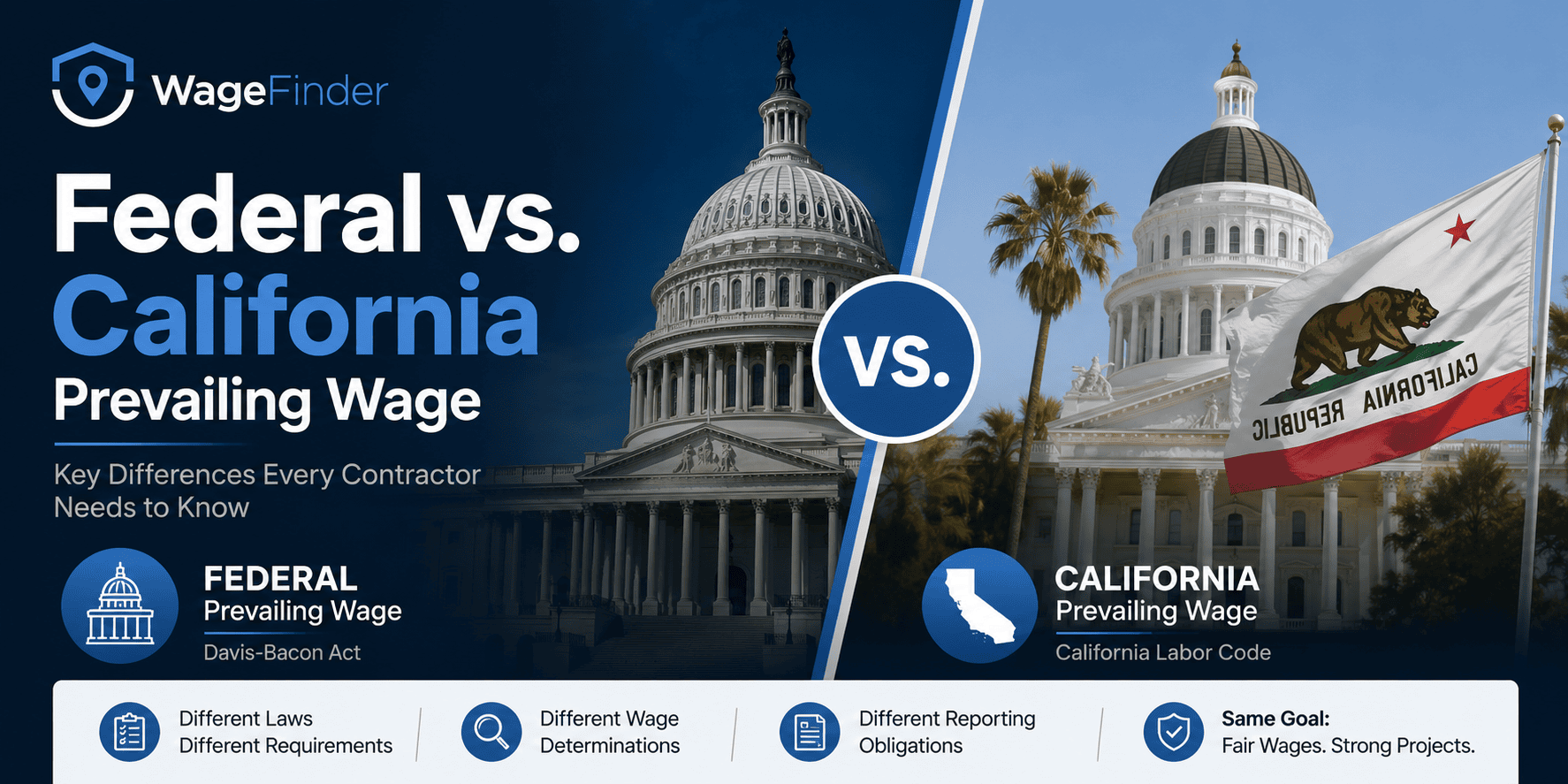
While both systems are designed to ensure workers receive fair wages, they differ significantly in coverage, wage determinations, reporting requirements, enforcement, and compliance obligations.
Choosing the wrong wage determination or misunderstanding which law applies can result in back wages, penalties, project delays, and audits.
In this guide, we’ll break down the key differences between federal and California prevailing wage laws and explain how to determine which requirements apply to your project.
What Is Federal Prevailing Wage?
Federal prevailing wage requirements stem primarily from the Davis-Bacon Act, which requires contractors and subcontractors on qualifying federally funded construction projects to pay workers no less than the locally prevailing wage and fringe benefits.
Federal prevailing wage generally applies when:
- A project receives federal funding or federal assistance
- The construction contract exceeds $2,000
- The project involves public buildings or public works
Examples include:
- Federal office buildings
- Military facilities
- Airports
- Bridges
- Highways
- Water treatment plants
The U.S. Department of Labor publishes wage determinations that specify the required wages for each worker classification and geographic area.
What Is California Prevailing Wage?
California has one of the nation’s most comprehensive prevailing wage programs.
Unlike federal prevailing wage laws, California’s requirements apply to many state-funded and locally funded public works projects, even when no federal funding is involved.
California prevailing wage is administered by the California Department of Industrial Relations (DIR).
Covered projects often include:
- Schools
- City infrastructure
- County construction
- Public utility improvements
- Transit projects
- Government buildings
California law frequently applies to a broader range of projects than federal law.
Side-by-Side Comparison
| Requirement | Federal Prevailing Wage | California Prevailing Wage |
| Governing Agency | U.S. Department of Labor | California Department of Industrial Relations (DIR) |
| Primary Law | Davis-Bacon Act | California Labor Code |
| Applies To | Federally funded public works | State and local public works |
| Wage Source | Federal Wage Determinations | California DIR Wage Determinations |
| Certified Payroll | Required on covered projects | Required on covered projects |
| Fringe Benefits | Separate fringe requirements | Included under California rules with specific treatment |
| Enforcement | U.S. Department of Labor | California Labor Commissioner & DIR |
Which Projects Follow Federal Law?
Projects generally fall under federal prevailing wage when federal funding is involved.
Examples include:
- VA hospitals
- Federal courthouses
- Military installations
- FAA projects
- Federal highway improvements
Many infrastructure projects funded through federal grants also trigger Davis-Bacon requirements.
Which Projects Follow California Law?
California prevailing wage commonly applies to:
- School districts
- Community colleges
- County projects
- City improvements
- Water districts
- Public transportation
- Affordable housing developments receiving qualifying public funding
Even relatively small local government projects may require compliance.
Can Both Laws Apply?
Yes.
Some projects receive both federal and California funding, meaning contractors may need to comply with both federal Davis-Bacon requirements and California prevailing wage laws simultaneously.
When dual coverage exists, contractors must carefully review:
- Applicable wage determinations
- Funding sources
- Contract language
- Agency guidance
- Reporting requirements
Because dual-covered projects can be complex, many contractors establish internal compliance procedures or use software to help validate wage rates and payroll calculations before processing payroll.
Wage Determinations: Federal vs. California
One of the biggest differences is where wage rates originate.
Federal
Federal wage determinations are published by the U.S. Department of Labor and are organized by:
- State
- County
- Construction type
- Worker classification
California
California publishes wage determinations through the Department of Industrial Relations.
California rates often include:
- Multiple shift differentials
- Holiday provisions
- Zone pay
- Travel pay
- Detailed apprentice schedules
- Union-specific classifications
As a result, California wage determinations are often more detailed than federal wage determinations.
Certified Payroll Requirements
Both systems require certified payroll reporting, but there are important differences.
Federal projects generally require:
- Form WH-347 (or an approved equivalent)
- Weekly payroll submissions
- Wage determination references
California projects require:
- Certified payroll records submitted electronically through the DIR’s Certified Payroll Reporting (CPR) system when applicable
- Public works registration
- Contractor registration with the DIR
- Additional state-specific reporting requirements
Understanding which reporting system applies is essential to maintaining compliance.
Common Compliance Challenges
Whether working under federal or California prevailing wage laws, contractors frequently encounter issues such as:
- Incorrect worker classifications
- Using outdated wage determinations
- Missing fringe benefit calculations
- Misclassifying apprentices
- Incorrect overtime calculations
- Reporting errors
- Employees working across multiple projects with different wage requirements
These issues can increase the risk of audits, payment delays, and back wage assessments.
How to Determine Which Prevailing Wage Applies
Before beginning any public works project, contractors should review:
- Funding source
- Project owner
- Bid specifications
- Contract documents
- Applicable labor compliance requirements
- Agency-issued wage determinations
Understanding these factors early helps ensure payroll is set up correctly before work begins.
Best Practices for Compliance
Successful contractors typically:
- Verify wage determinations before work starts.
- Review funding sources carefully.
- Train payroll staff on prevailing wage requirements.
- Track employee classifications accurately.
- Maintain detailed payroll records.
- Monitor wage determination updates throughout the project.
- Use technology to validate wages before payroll is processed.
Taking a proactive approach can significantly reduce compliance risk.
Frequently Asked Questions
Is California prevailing wage the same as Davis-Bacon?
No. Davis-Bacon is a federal law governing many federally funded construction projects, while California has its own prevailing wage laws that apply to many state and local public works projects.
Can both federal and California prevailing wage apply to the same project?
Yes. Projects funded by both federal and California sources may require compliance with both sets of prevailing wage requirements.
Who publishes California prevailing wage rates?
The California Department of Industrial Relations (DIR) publishes prevailing wage determinations for public works projects throughout the state.
Which law has stricter requirements?
Requirements vary depending on the project, but California’s prevailing wage program is generally considered more detailed due to its broader classification system, reporting requirements, and additional labor compliance rules.
How do I find the correct prevailing wage?
Contractors should review the project’s funding source and applicable wage determinations before beginning work. Using a searchable prevailing wage database can simplify this process and help ensure the correct rates are identified by state, county, classification, and construction type.
Final Thoughts
Although federal and California prevailing wage laws share the same goal—ensuring workers receive fair wages on public construction projects—they differ in important ways. Understanding which law applies, where to find the correct wage determinations, and how reporting requirements vary can help contractors avoid costly compliance mistakes.
Whether you’re working on a federally funded infrastructure project or a California public works contract, having quick access to accurate prevailing wage information is essential.
WageFinder makes it easy to search prevailing wage determinations by state, county, worker classification, and construction type, helping contractors, payroll professionals, and compliance teams locate the information they need more efficiently.
About
WageFinder, powered by HCM TradeSeal, makes prevailing wage research faster and easier.
Built from HCM TradeSeal’s expertise in prevailing wage and labor compliance, WageFinder provides access to more than 1.8 million federal, state, and local prevailing wage records in one searchable platform.
Instead of spending time searching through government websites, PDFs, and other sources, users can quickly find the wage information they need. For organizations looking to bring prevailing wage data directly into their own systems, WageFinder also offers API access for more streamlined workflows. Find the right rates, faster.